Machine-Learning Time-Dependent Density Functional Theory on a Lattice
Project Context and Objective
Accurately modelling the time evolution of a system of interacting particles is a fundamental
challenge in physics. Many body systems, including the gravitational interactions of celestial
bodies, the behaviour of molecules in a gas, and quantum systems, exhibit complex, nonlinear
behaviour arising from particle interactions. As the system size increases, direct numerical
simulation becomes exponentially more computationally expensive, prompting the use of reduced
representations and data-driven modelling approaches.
My undergraduate thesis investigated the use of machine learning to predict the time evolution
of a many-body quantum system defined on a lattice. The objective was to assess the capabilities
of a trained neural network on a reduced representation of the system, enabling investigation of
a scaled system without the associated computational cost. This would provide a more efficient tool
than direct numerical simulations of the system.
Methodology
Using Python, I developed a numerical simulation of the interacting particle system based on
the governing many-body equations.
Generated a dataset for the time evolution of the system for a range of evenly sampled initial
conditions.
Trained a neural network to predict the system's time evolution directly from its initial state.
Evaluated the performance of the model using a reduced representation of the system to improve the
computational efficiency.
Investigated the influence of varying the interaction strength between particles on the predictive
accuracy of the model.
Results
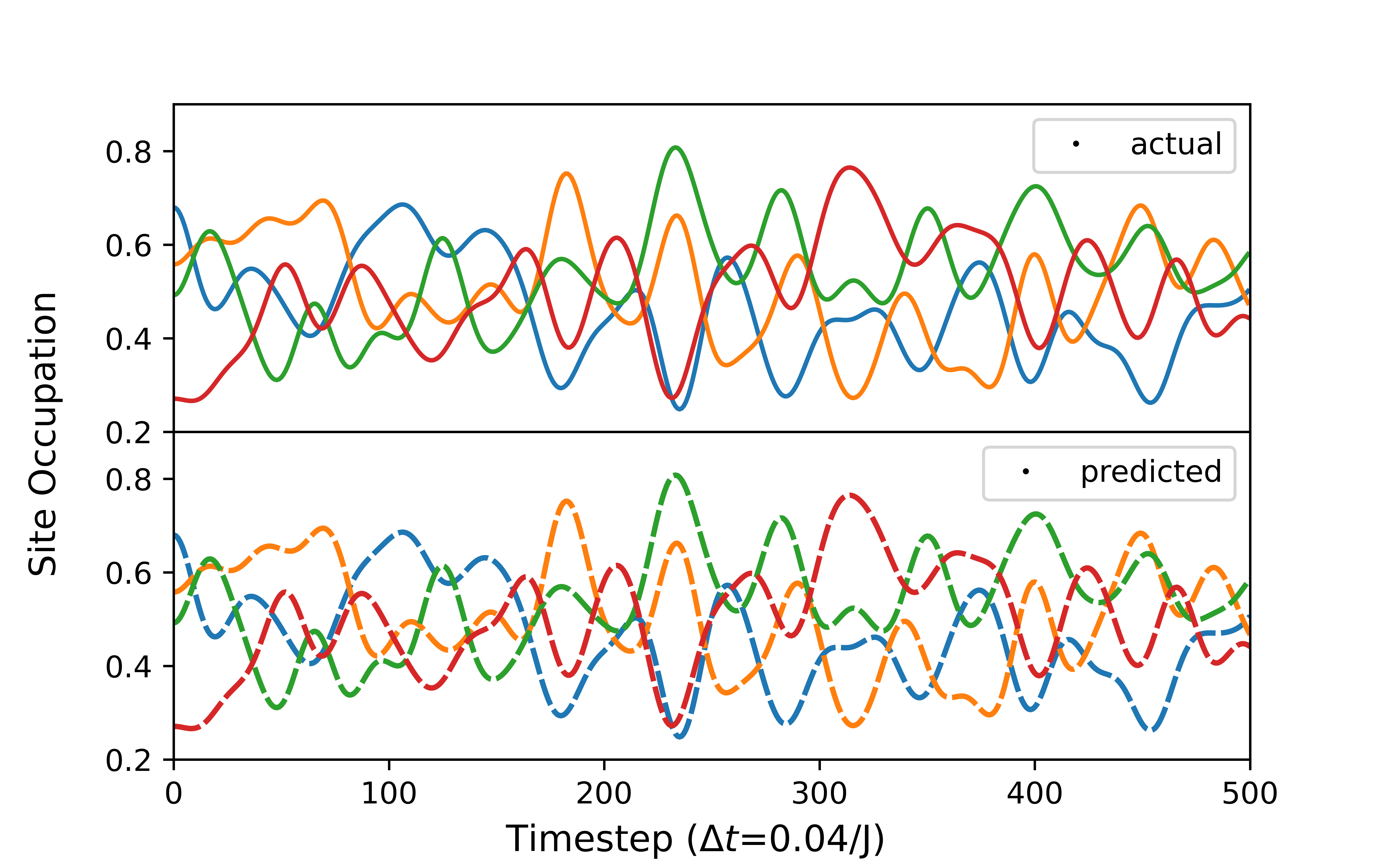
Successfully trained a neural network to accurately predict the time evolution of the system given
a set of initial conditions.
Reconstruction of the system time evolution by a neural network given the initial full representation
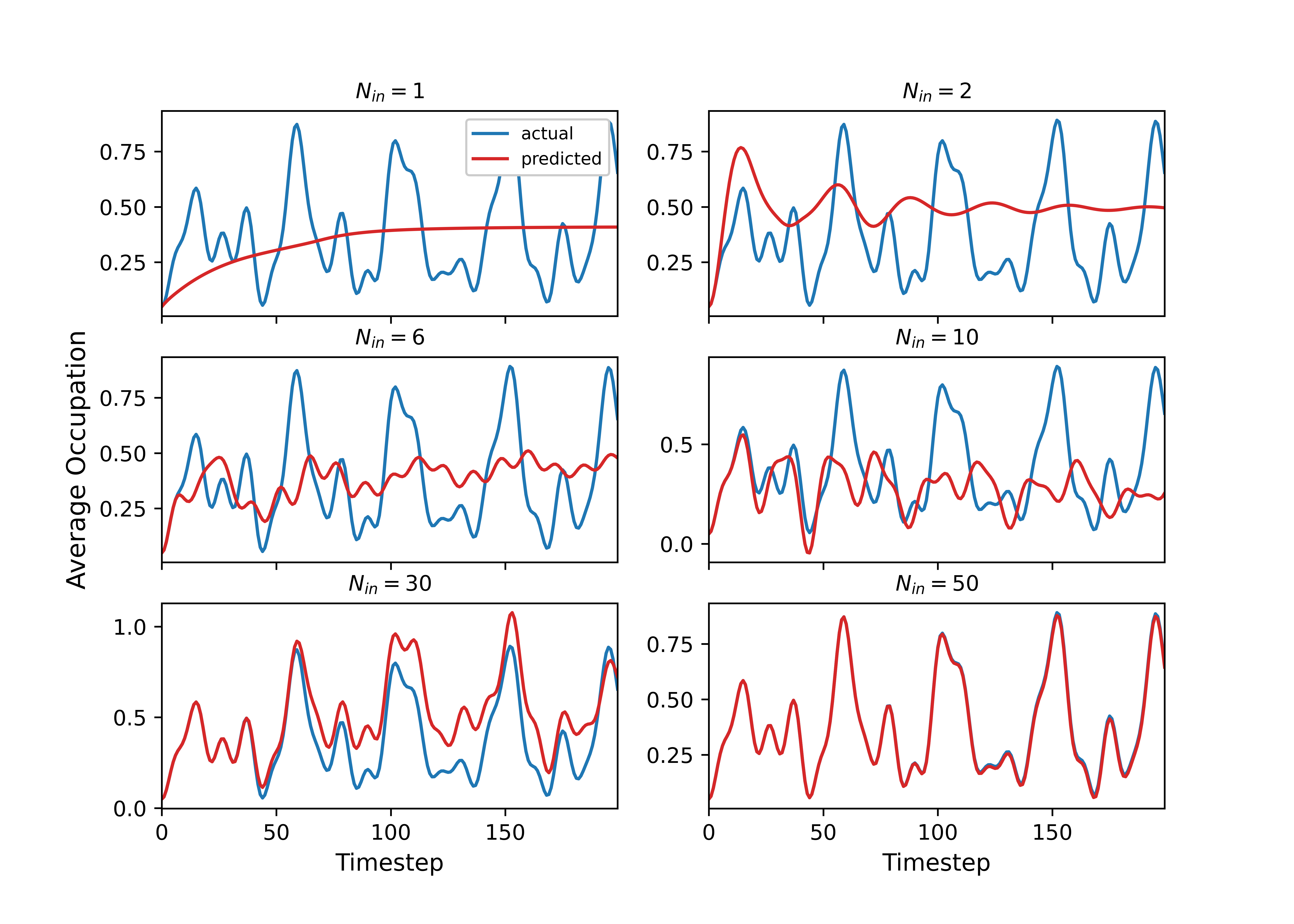
Demonstrated that for the reduced representation of the system, the predictive accuracy of the model
was significantly reduced. The model must be trained on an increased number of timesteps to make accurate
long-term predictions.
Reconstruction of the system time evolution by a neural network given variable number of input timesteps of the system's reduced representation
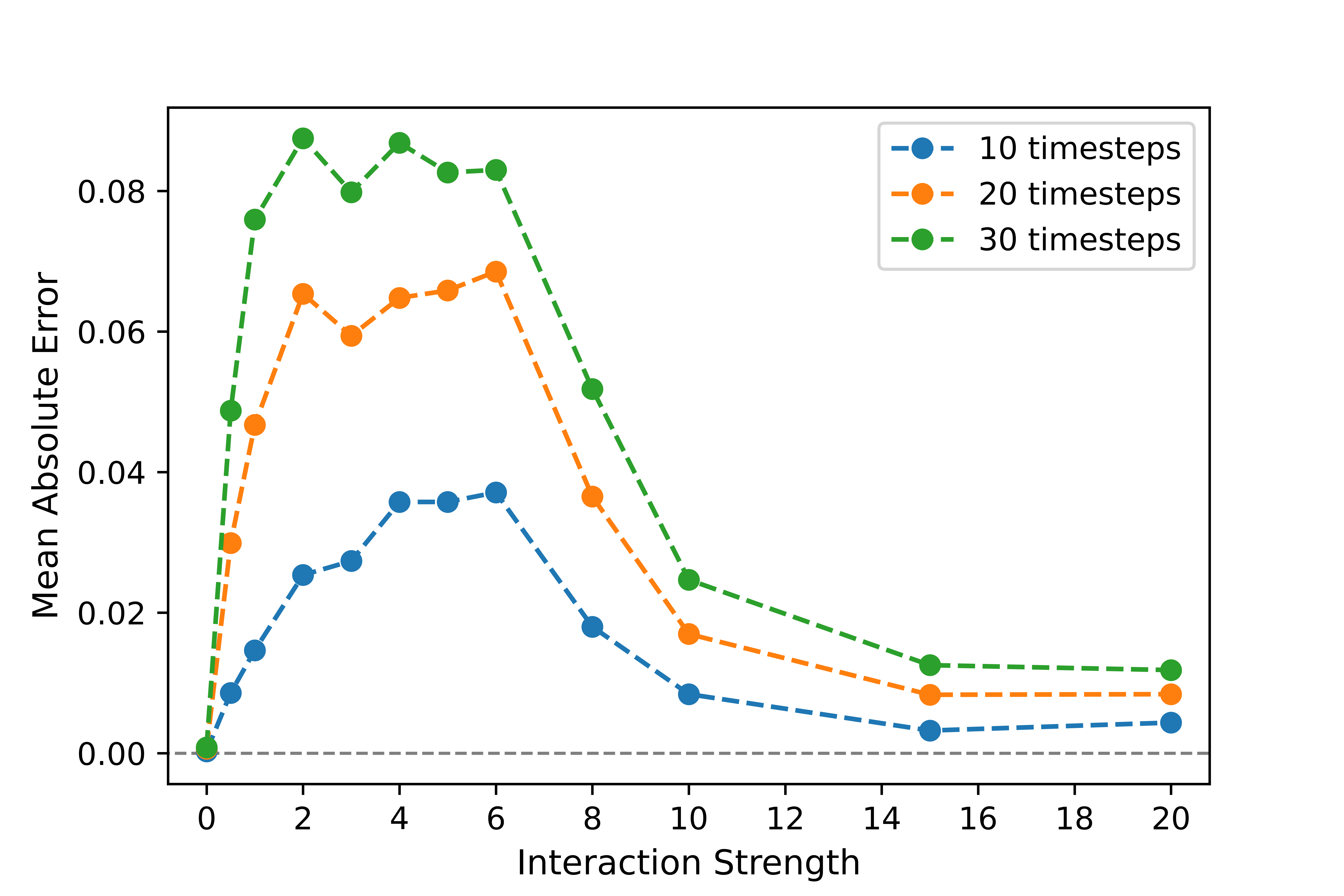
By varying the relative interaction strength between the particles in the model, it was shown that the
intermediate interaction regime exhibited the most chaotic particle behaviour that was most difficult
for the ML model to predict.
Neural network accuracy for varying particle-to-particle interaction strength
Transferable Engineering Skills
Although this project is rooted in theoretical physics, it has developed several skills that are directly
applicable to a simulation and modelling engineering role:
Transferring a mathematical model into a Python-based numerical tool.
Validating the numerical model against expected physical behaviour.
Generating and processing large datasets from simulations.
Designing, training and evaluating a neural network for a time series prediction task.